

The availability of skilled and labor workers is becoming an increasing challenge for the region. To secure future economic performance, it is essential to unlock skilled labor potential and ensure the availability of skilled and labor workers for the regional economy. The Region Aachen Special Purpose Association (RAZV) has therefore taken the initiative to bundle regional activities on this topic. Representatives of the regional economic clusters have now agreed with the RAZV to collaborate even more closely in the future to jointly advance the economic development of the region.
“I am very pleased about this extremely strong sign of willingness to cooperate. Such a strong alliance of business, science, and administration has not existed before in the Aachen region. But together we are simply more effective, louder, and stronger than each of us alone,” says Ulla Thönnissen, Managing Director of the RAZV, on the occasion of signing the cooperation agreement. “Cooperation means not only working together but also growing together, learning from each other, and utilizing synergies. If each of us—especially in our heterogeneity and diversity—contributes their part, we can develop an economic strength that radiates far beyond our region.” As part of a joint regional marketing effort for the entire area—from Düren through Euskirchen, Heinsberg, and the Städteregion Aachen—the partners want to pool their strengths to ensure a confident presentation of the entire economic region externally and to speak with one strong voice. Through this collaboration, they expect greater impact and significantly more visibility. Additionally, this approach avoids duplicated efforts and structures, and creates an efficient representation of interests with streamlined structures.
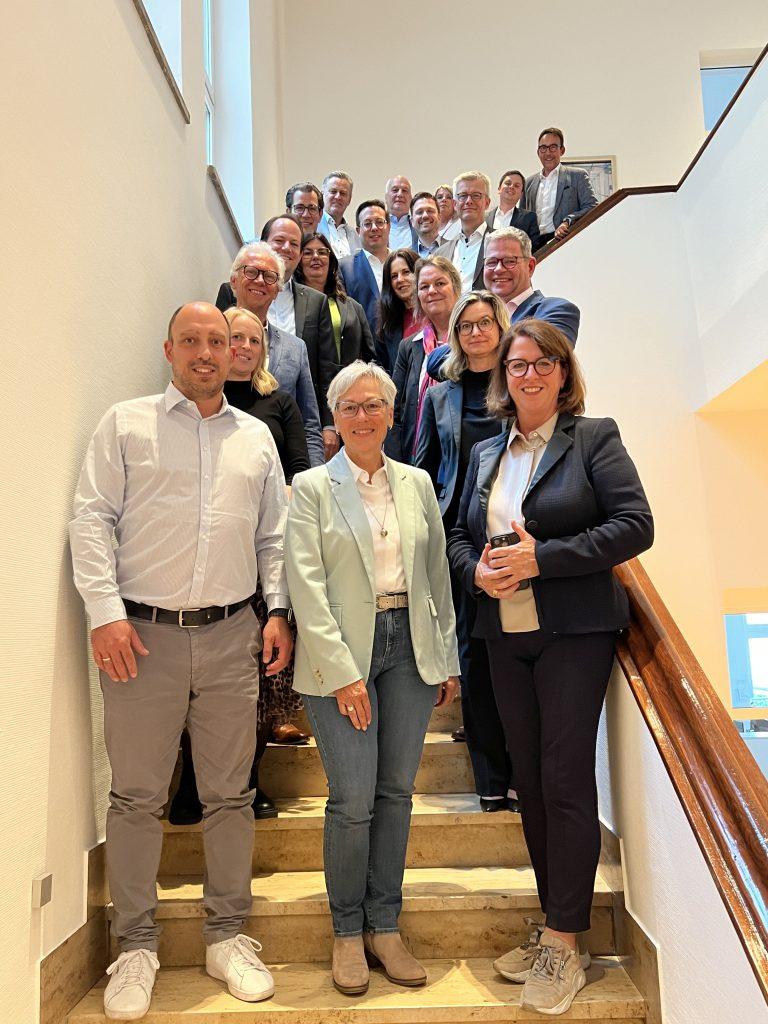
For the first time, all important regional clusters have agreed to cross-sector collaboration on behalf of their member companies and sealed it with signatures. The cooperation contract was signed by: AACHEN BUILDING EXPERTS e.V., competence center automotive region aachen|euregio maas-rhein e. V. (car e. V.), digitalHUB Aachen e. V., Eifel Tourismus (ET) GmbH, LASER.region.AACHEN, MedLife e. V., MineReWIR e.V., REGINA e.V. Together, they represent over 1,000 companies in the region. All of them share the shortage of skilled and labor workers. “A clear goal of our cooperation must be a joint skilled workers campaign that promotes the many advantages of our region externally,” says Dr. Oliver Grün, Chairman of digitalHUB Aachen, about the motivation to engage in this alliance. Nationwide, there are 159,000 unfilled positions in the IT sector alone.
Edwin Büchter from LASER.region.Aachen wants to convey the message that the Aachen region is a valuable and livable place, especially for high potentials. It cannot be that graduates trained at RWTH and FH Aachen turn their backs on the region after finishing their studies. “This cooperation will jointly carry the radiance of our economic area outward,” Büchter is convinced.
The oldest industry clusters—car for the automotive sector, REGINA for IT companies, and MedLife for biotechnology—have been working together for many years, especially on the topic of securing skilled workers, and they attend bonding fairs together. “Together, we can achieve a lot if we speak with one voice externally, utilize synergies, and avoid redundancies,” emphasize the chairpersons of the three clusters: Tim Willers from car, Christoph Ptock from MedLife, and Hajo Noerenberg from REGINA. However, the collaboration should not stop at state borders. “If we work much more closely with companies on the Belgian and Dutch sides of the Euregio, we need not fear other regions,” says Willers. A survey by REGINA e.V. among employees of IT companies, Noerenberg reports, showed that the proximity to the Belgian and Dutch coasts as well as their metropolitan areas was especially appreciated. Noerenberg: “We are the only region in NRW located at a tri-border area. We need to emphasize this quality of life and leisure even more.” After all, over four million people live in the Euregio Maas-Rhine, adds Ptock. “That also makes us a very strong region.”
Prof. Dr. Elisabeth Clausen from MineReWir is convinced that the now formally documented cooperation of the clusters with the RAZV will better enable the necessary structural change. “With our respective competencies, we complement each other to jointly advance the overarching goal of strengthening our economic region.”
The Eifel is considered an important part of the Aachen region. Although it already has supra-regional appeal as a tourist destination, it is still too little perceived as an economic location. “We are known as an attractive leisure region but especially want to make our companies more visible, as they are also desperately searching for personnel,” explains Klaus Schäfer, Managing Director of Eifel Tourismus GmbH for the Eifel Future Initiative, regarding the commitment to the newly created alliance. Dr. Hans-Jürgen Krause from AACHEN BUILDING EXPERTS expects mainly synergies from the cooperation. “We hope for impulses for the construction industry on topics not directly related to construction, such as digitalization. If each partner brings in the specific competencies of their sector, it will be a gain for each cluster as well as for the companies located here and the people living and working here.” The future challenges can only be mastered jointly as a strong network.