

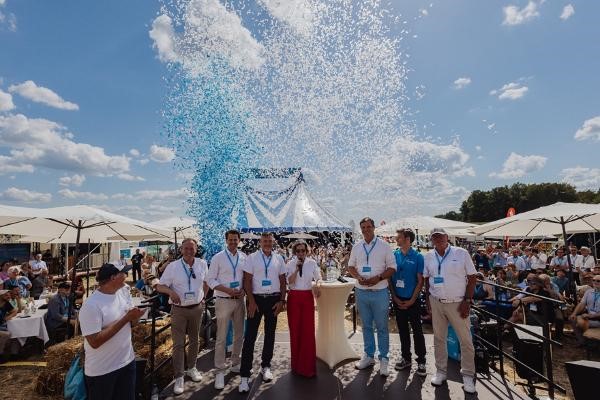
Perfect summer weather, an unusual venue, and around 1,000 participants over two days: the REGIONALE 2025 tent festival, held on July 11 and 12, 2026, in Much, served as a fitting conclusion to the 15-month presentation period themed “Eager for the Future!” The event provided an ideal setting for a diverse program that—under the title “The Good Life, Made by Us!”—highlighted volunteer engagement in the Bergisches RheinLand region. At the same time, the festival marked the finale of this state structural development program. After eight years of successful project development, this “temporary state of exception” came to an end.
The first day focused entirely on civic engagement: the REGIONALE’s key theme regarding the future was explored through high-caliber panel discussions, lectures, and an accompanying exhibition. A total of nine project showcases—covering the topics “Together, Not Alone,” “Local Culture,” and “Well-Cared-For”—provided ongoing opportunities throughout the day for professional exchange and presented around 30 concrete, real-world examples of successful volunteer projects from the Bergisches RheinLand and North Rhine-Westphalia. The tent festival was organized by the REGIONALE 2025 Agency in collaboration with its shareholders: the districts of Oberbergischer Kreis, Rheinisch-Bergischer Kreis, and Rhein-Sieg-Kreis, as well as the association Region Köln/Bonn e.V.
The festival site—a meadow in Much—offered visitors exciting views across the Bergisches RheinLand and as far as the Siebengebirge hills. Proceedings kicked off inside a circus tent that served as a “temporary landmark,” visible from afar. Right from the start, REGIONALE Managing Director Dr. Reimar Molitor emphasized the importance of volunteering for social cohesion, viewing it primarily as a structural policy task that remains a constant priority. In his subsequent welcoming remarks, Much Mayor Karsten Schäfer reaffirmed the importance of volunteer work—particularly for municipalities covering large geographic areas like Much—and emphasized that the Bergisches RheinLand region thrives thanks to people who roll up their sleeves and get things done. Sebastian Schuster, District Administrator of the Rhein-Sieg district, underscored this point in his own speech. He noted that as the state increasingly withdraws from various sectors, there is a growing need for places where people can meet and interact. It is precisely for this reason that numerous projects facilitating such encounters have been launched under the REGIONALE initiative.
Keynote by Minister Silke Gorißen
In her subsequent keynote address, Silke Gorißen, Minister for Agriculture and Consumer Protection of North Rhine-Westphalia, acknowledged the significant progress made in the Bergisches RheinLand region in recent years. She noted that local residents are taking responsibility and using their ideas to create favorable living conditions. She praised the work of the REGIONALE initiative, which over the past eight years has preserved and created spaces where people can come together and actively shape their local community. She emphasized that the courage to collaborate will remain essential in the future; the partnerships forged through the REGIONALE initiative are enduring and help strengthen democracy. At the same time, she urged stakeholders to make use of available funding instruments, such as the LEADER program or foundation grants. Earlier, the Minister had toured the exhibition accompanying the tent festival and spoken with exhibitors, including the foundations of Kreissparkasse Köln, the RheinEnergieStiftung, the Hans Hermann Voss Foundation, the German Foundation for Engagement and Volunteering (DSEE), the NRW Foundation, and the Much Foundation.
A Plea for “Laboratories of Democracy”
At midday, political scientist Prof. Em. Dr. Claus Leggewie picked up on the motto of the REGIONALE presentation period during his keynote speech, posing the question of how to inspire enthusiasm for the future. First, the scholar argued, it is necessary to paint a bleak picture of the present—a point he illustrated with three examples: the intense pressure on municipal finances; growing societal dissatisfaction coupled with the rising threat to democracy posed by right-wing ideologies; and the overburdening of volunteers. To rekindle enthusiasm for the future, Leggewie posited that we must, in particular, re-establish so-called “third places”—spaces that are enjoyable and serve as meeting points for friends. Such gathering spots—pubs, late-night convenience stores, and gas stations, for instance—have increasingly disappeared in recent years. He urged citizens to create these “laboratories of democracy” themselves, thereby establishing tangible, vibrant venues for exchange. “Promoting democracy does not end where I oppose something; it begins where I stand for something,” Leggewie concluded.
Working Together Makes a Good Life Possible
Afterwards, journalist and author Dr. Martin Stankowski discussed with Leggewie, Alexandra Gauß (Mayor of the Municipality of Windeck), Sabine Müller (Board Member of Villa Much e.V.), Silvia Assmussen (Volunteer Initiative “Weitblick” of the Oberbergischer Kreis district), and Jochen Hagt (Board Member of the Hans Hermann Voss Foundation) what is needed to achieve a good quality of life at the local level. Assmussen noted that the volunteer sector in the Oberbergischer Kreis district is well-positioned, with people independently approaching the district administration with ideas—citing urban gardening projects and repair cafés as prime examples. Jochen Hagt confirmed this observation: the more village-like the structures, the greater the level of volunteer engagement. The Bergisches RheinLand region—with its decentralized settlement pattern (the Oberbergischer Kreis district alone comprises over 1,400 villages)—has always been an area where people roll up their sleeves and “create a good life for themselves.”
Alexandra Gauß emphasized that municipalities value intrinsically motivated individuals and that, in such cases, support options are almost always available. While initiating a project is easy, the mayor noted that the real challenge—the “crowning achievement”—lies in staying the course and “letting the younger generation get involved.” Sabine Müller shared her experiences with the REGIONALE project “Villa Much,” advising others to network with like-minded people who are eager to make a difference; such connections are essential for turning ideas into reality and ensuring the long-term implementation of projects. Claus Leggewie advocated for the greater use of citizens’ assemblies to solve specific local problems and to ensure that the decision-making process reflects a true cross-section of society.
lit.COLOGNE Returns to Bergisches RheinLand for the Third Time
On the second day, lit.COLOGNE provided the cultural highlight of the tent festival: the renowned literature festival made its third appearance in the region as part of the REGIONALE Bergisches RheinLand. Dr. In the first discussion round, Reimar Molitor and Rainer Osnowski—managing directors of lit.COLOGNE GmbH—spoke about volunteering with Sebastian Schuster (District Administrator of Rhein-Sieg-Kreis), Karsten Schäfer (Mayor of the municipality of Much), and Thomas Pennartz (Chairman of the Board of Kreissparkasse Köln/KSK). While Schäfer emphasized the importance of the REGIONALE project “Villa Much” and the wide range of services it offers to local residents, Pennartz highlighted Kreissparkasse’s role as an “instrument of public service provision” and an enabler within the region; he noted that the bank’s foundation programs are in high demand and provide financial backing for numerous projects. Pennartz argued that a positive future—and by extension, economic prosperity—can only emerge when support is given to people who want to initiate projects and make things happen in the region. Schuster affirmed that cooperation among the three districts would continue beyond the REGIONALE initiative, with plans to support and implement existing projects in the coming years while also launching new ones in the Bergisches RheinLand area.
Subsequently, prominent guests took the REGIONALE stage: Aleida Assmann (recipient of the Peace Prize of the German Book Trade), Cologne pastor Franz Meurer, and cabaret artist Jürgen Becker. A lively and refreshing conversation ensued regarding the changing nature of volunteering, its societal significance, and the question of how much civic engagement a society based on solidarity requires. The discussion was moderated by WDR presenter Julia Schöning.
Dialogue as the Foundation of Community
The discussion was prompted by the title of Assmann’s book *Gemeinsinn. Der sechste, soziale Sinn* (“Civic Spirit: The Sixth, Social Sense”), which she co-authored with her late husband, Jan Assmann. In it, she incorporated the concept of *sensus communis*—originally coined by Aristotle—and recounted its history: “People do not live autonomously; they depend on one another. The sixth sense is innate; we all possess this social sense, yet we must bring it back into our consciousness,” said Assmann. Franz Meurer shared this view. Meurer, who was recently awarded the Mevlüde-Genç Medal by the state of North Rhine-Westphalia for his volunteer work, emphasized the human desire for a sense of home and advocated for greater integration of newcomers into the community. “Dialogue is the foundation of a sense of community,” the pastor stated.
When asked about the importance of community gathering places, Jürgen Becker spoke of his childhood in Kürten-Olpe and the village pub as a place for people to meet: “I see this at my cabaret shows, too: the most important thing is the beer afterwards. It’s not really about whether I actually drink a beer or not, but about the invitation itself.” Assmann picked up on this thought, noting that in an age of digitalization, people value these central meeting places all the more because they foster a sense of community and offer a tangible, lasting experience. This is evident in the fact that such moments tend to remain in people’s memories much more vividly. When the conversation turned to the role of churches as meeting places, Meurer observed that lifestyles have changed and not everyone has the time to go to church. “If I weren’t a pastor, I wouldn’t go to church every day either,” Meurer candidly admitted, drawing laughter from the audience.
“Volunteering is the oxygen of democracy”
The conversation then took a decidedly political turn. Democracy is a demanding form of government that requires places of community to remain stable. Only in such settings can a sense of shared humanity emerge, Assmann emphasized. Helping one another is a fundamental human duty; every action has consequences for others. That is why volunteering is “the oxygen of democracy,” she stressed, earning enthusiastic applause from the audience. Towards the end of the discussion, Becker summed it up simply: “You have to go where you’re needed, rather than expecting people to come to you.”
The event was accompanied by the internationally renowned jazz musicians Julian and Roman Wasserfuhr from Hückeswagen. They performed tracks from their album *Echoes_Sound of Home*—produced specifically for the REGIONALE—creating a musical soundtrack for the Bergisches RheinLand region. REGIONALE as a Model for Export
At midday, REGIONALE Managing Director Reimar Molitor—together with stakeholders from the Bergisches RheinLand—deliberately focused on the future: the tent festival had sparked numerous new project ideas, fostered connections between people, and highlighted prospects for future funding opportunities. In doing so, the REGIONALE provided important impetus for the further development of civic engagement in the region. Molitor emphasized that the networks formed during the event would endure and that the REGIONALE had successfully shone a spotlight on the area. This has not gone unnoticed in other federal states, either; among the many guests was Steffen Schütz, Minister for Digital Affairs and Infrastructure for the Free State of Thuringia. He visited the tent festival with a delegation to learn more about the REGIONALE format. Thuringia is seriously considering establishing its own REGIONALE; Schütz described his impression of the Bergisches RheinLand as extremely positive, noting that it serves as a fantastic example of the tangible promotion of democracy. Ceremonial Conclusion with Minister Ina Scharrenbach
To mark the conclusion, Ina Scharrenbach—Minister for Regional Identity, Local Government, Building, and Digitalization for the State of North Rhine-Westphalia—offered her congratulations on eight successful years: “The best of both worlds: The Bergisches RheinLand is a treasure that REGIONALE 2025 has made even more visible. Thanks to the state structural program, projects addressing five key themes for the future have been launched over the past eight years across the Oberbergischer Kreis, Rheinisch-Bergischer Kreis, and the eastern Rhein-Sieg-Kreis—projects that dare to innovate and build the future. The REGIONALE in the Bergisches RheinLand has become a driving force for the economy, progress, and community life, particularly regarding the innovative use of resources and the associated regional transformation processes; this has generated genuine, authentic added value. And it is the local citizens who benefit most from this. The State of North Rhine-Westphalia was pleased to support this successful collaboration. Here, the relationship between city and countryside—between the urban Rhine corridor and the rural Bergisch region—can be experienced on equal terms. In this way, a sense of ‘home’ has been shaped in the best possible sense.” Finally, the Minister brought REGIONALE 2025 Bergisches RheinLand to a close with the declaration: “The REGIONALE has ended; the future has begun!” Afterwards, the guests enjoyed the final moments of the tent festival together.