Search
  • Deutsch
  • English
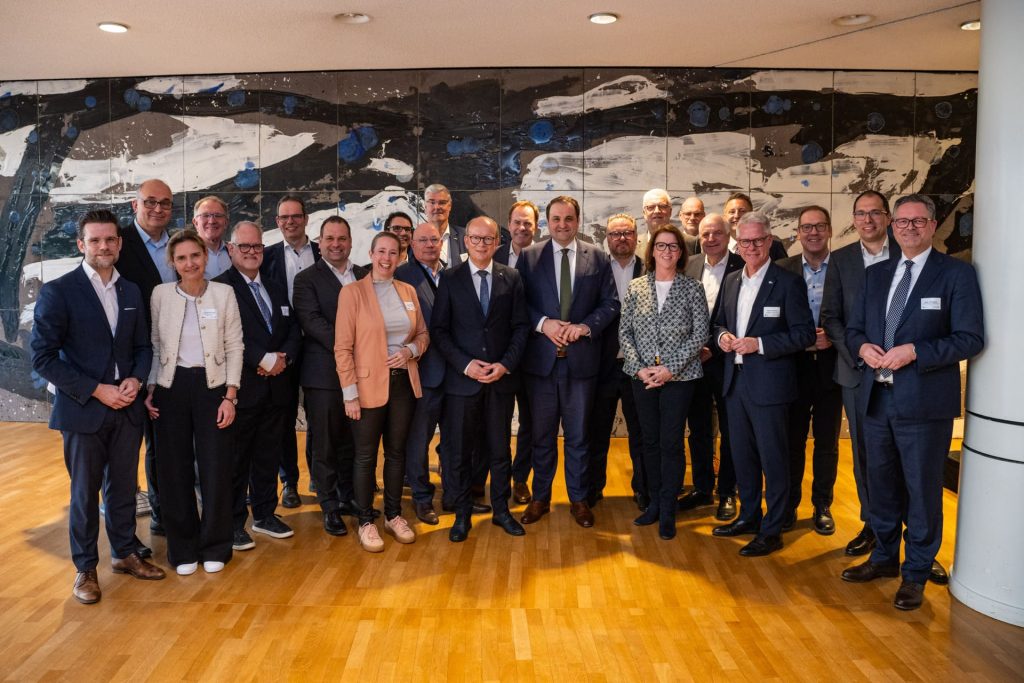
Foto: regionen.NRW/Arne Pöhnert
(v.l.n.r.): Felix Heinrichs, Oberbürgermeister Stadt Mönchengla-dbach; Prof. Dr. Peter Gust, Bergische Universität Wuppertal; Dr. Bettina Warnecke, Landrätin Kreis Mettmann; Gregor Berghau-sen, IHK Düsseldorf; Dr. Raphael L’Hoest, Bundesministerium für Wirtschaft und Energie; Andreas Grotendorst, Vorstand Müns-terland e.V.; Dennis Rehbein, Oberbürgermeister Stadt Hagen; Vera Bökenbrink, Geschäftsführerin Stahlwille GmbH; Dr. Kai Büter, Regionalmanagement Düsseldorf/Kreis Mettmann; Ste-phan A. Vogelskamp, Bergische Struktur- und Wirtschaftsförde-rungsgesellschaft mbH; Markus Schlüter, Regionalverband Ruhr; André Kuper, Präsident des Landtags Nordrhein-Westfalen; Dr. Stephan Keller, Oberbürgermeister Landeshauptstadt Düssel-dorf; Nathanael Liminski, Minister für Bundes- und Europaange-legenheiten, Internationales sowie Medien des Landes Nord-rhein-Westfalen und Chef der Staatskanzlei; Björn Böker, Ost-WestfalenLippe GmbH; Garrelt Duin, Regionaldirektor Regional-verband Ruhr; Ulla Thönnissen, Region Aachen Zweckverband; Christof Sommer, Hauptgeschäftsführer Städte- und Gemeinde-bund NRW; Rainer Deppe, Vorsitzender Regionalrat Köln, Thomas Schürmann, Regierungspräsident Bezirksregierung Düs-seldorf; Jürgen Steinmetz, IHK Mittlerer Niederrhein; Hubertus Winterberg, Südwestfalen-Agentur GmbH; Bertram Gaiser, Standort Niederrhein GmbH; Bodo Middeldorf, Zukunftsagentur Rheinisches Revier

Spring Reception of NRW Regions: Ideas for New Forms of Cooperation

Around 150 guests from politics, municipalities, business, and academia discussed both traditional funding programs and new cooperation models at the spring reception of the regionen.NRW network, held at the state parliament in Düsseldorf on Tuesday, March 17.

In the opening remarks, President of the State Parliament André Kuper pointed to the acute financial challenges faced by municipalities, noting that around €30 billion is missing nationwide this year. At the same time, he emphasized: “The major transformations of our time are shaped locally – in our cities and regions. As different as they may be, they share the ability to actively shape change and to overcome challenges together. Here, the federal government, the state, municipalities, and the business community share a joint responsibility.”

Nathanael Liminski, Minister for Federal and European Affairs, International Affairs and Media, and Head of the State Chancellery, also underlined the importance of regions in Europe on behalf of the state government: “In Brussels, too, during the current negotiations on the upcoming EU budget, it must remain clear: Europe’s strength lies in its regions. We must continue to ensure that decision-making on the use of funding remains within the regions.”

Ulla Thönnissen, Managing Director of the Region Aachen Special-Purpose Association, welcomed the participants on behalf of all regions in the network. In a panel discussion, representatives from business as well as from the state, federal, and municipal levels discussed concrete financing approaches. Participants included Vera Bökenbrink, Managing Director of STAHLWILLE, Garrelt Duin, Regional Director of the Ruhr Regional Association, Dr. Raphael L’Hoest from the Federal Ministry for Economic Affairs and Energy, and Christof Sommer, Managing Director of the Association of Cities and Municipalities of North Rhine-Westphalia.

The exchange continued in personal conversations during the subsequent reception.

More news

Perfect summer weather, an unusual venue, and around 1,000 participants over two days: the REGIONALE 2025 tent festival, held on July 11 and 12, 2026,

56 projects underway – 150 million euros in grants and third-party funding – total investment of 250 million euros – the South Westphalia Network continues

To mark the start of summer on the longest day of the year—June 21, 2026—participants from across the Cologne/Bonn region gathered at the Beethoven Hall

The network regionen.NRW, which brings together the nine regional development organizations in North Rhine-Westphalia as well as the Zukunftsagentur Rheinisches Revier, met with Markus Töns,

Around 150 guests from politics, municipalities, business, and academia discussed both traditional funding programs and new cooperation models at the spring reception of the regionen.NRW