

56 projects underway – 150 million euros in grants and third-party funding – total investment of 250 million euros – the South Westphalia Network continues to grow
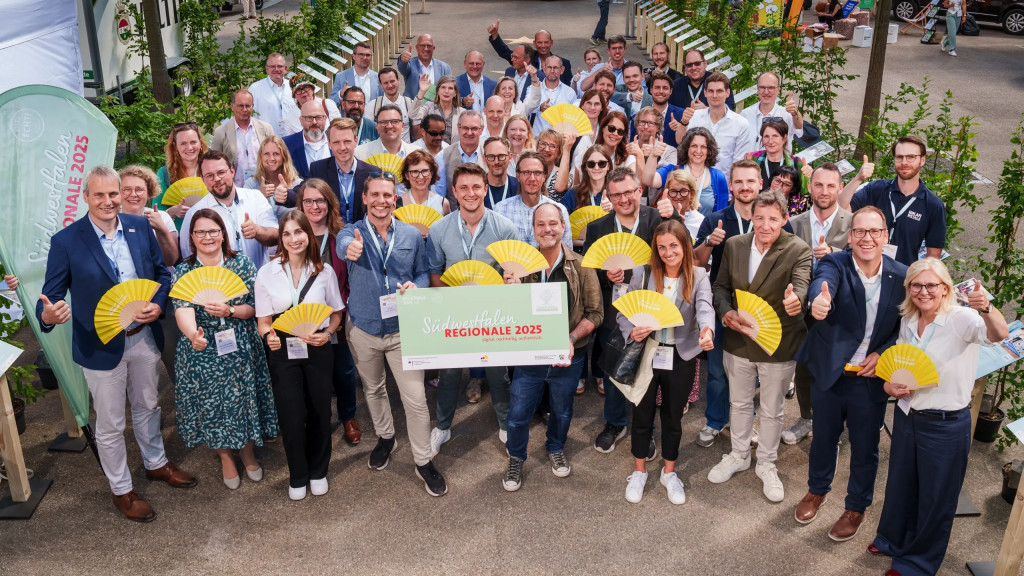
For eight years, hundreds of dedicated individuals across the region have worked on projects and strategies for the future of South Westphalia as part of REGIONALE 2025. It is now time for the South Westphalia Agency—which coordinated the regional process—to take stock. Fifty-six projects spanning urban development, the circular economy, nature, culture, mobility, sustainable construction, digital education, and business support are currently being implemented or are about to launch. They fit together like puzzle pieces, collectively strengthening the region. In total, REGIONALE 2025 has secured around 150 million euros in grants and third-party funding for the area, with a total investment volume of 250 million euros.
“What matters is how the funds are used,” said Ralf Schwarzkopf, District Administrator of Märkischer Kreis and Chairman of the Supervisory Board of the South Westphalia Agency. “Many committed people are working to keep our towns and cities livable, expand digital expertise, and support small and medium-sized enterprises as they undergo digital and sustainable transformation. That is exactly the right path to take.”
South Westphalia taps into full funding potential: 60 million euros for business and higher education projects
For the first time, the state of North Rhine-Westphalia made a special budget from the European Regional Development Fund (ERDF) available for the REGIONALE initiative. Up to 60 million euros were earmarked for South Westphalia—specifically for projects involving collaboration between higher education institutions and businesses, support for companies developing new business models, and initiatives that strengthen the circular economy. “Within just a few months, the region succeeded in developing 17 projects from scratch to the point where they were ready for implementation and funding. As a region, we were able to access the entire 60-million-euro budget. That is by no means a given,” said Schwarzkopf.
In addition to this special budget, the REGIONALE projects receive funding from around 30 different funding sources. Together with the Arnsberg District Government and the ministries, the Südwestfalen Agency sought funding opportunities for the innovative ideas of the project leaders.
Collaboration Put into Practice – Rising to the Challenge
Compared to the 2013 Regionale, the hurdles facing the region during REGIONALE 2025 were significantly higher: the coronavirus pandemic, the closure of the A45 bridge, floods, bark beetle infestations, a hacker attack on Südwestfalen-IT, and many other issues had a direct impact on the process. Many stakeholders who would normally be involved simply had their minds on other things. At the same time, expectations were higher because the challenges facing companies and municipalities are becoming increasingly complex. It is all the more remarkable, then, that people in the region submitted over 200 ideas, with 56 actually being implemented, said Hubertus Winterberg, Managing Director of the Südwestfalen Agency. “In moments like these, we benefit from the fact that we have effective regional structures in place and can achieve a great deal through collaboration.”
The agency managed the REGIONALE 2025 process, organized committee work, advised and supported project leaders, and arranged around 200 events. These events served to bring like-minded people together, share best practices from the region, provide fresh impetus, and strengthen collaboration across municipal boundaries.
Even More Support for Cities – “Smart Cities” Complements REGIONALE
The federal pilot project “Smart Cities: 5 for South Westphalia” (Smart Cities: 5 für Südwestfalen) also emerged from REGIONALE 2025. The pioneering municipalities of Arnsberg, Bad Berleburg, Menden, Olpe, and Soest demonstrated what this somewhat complex term means for a rural region like South Westphalia. They make up the “5” in the project and have tested and implemented digital solutions for sustainable urban development. Initiatives include using data to save energy and manage traffic, better adapting cities to climate change, digitally strengthening volunteer work, and experiencing the unique characteristics of a city in new ways. They share their solutions with the entire region so that other cities can adopt them. This process has generated 61 initiatives that—much like the REGIONALE 2025 projects—are digital, sustainable, and authentic.
Over 300 project sponsors and partners—paving the way for the future
Around 300 project sponsors and partners—including cities, organizations, universities, companies, and many others—are driving the REGIONALE 2025 projects. “Without the innovative ‘digital, sustainable, and authentic’ approach, we wouldn’t have secured a second REGIONALE after 2013. The region seized the opportunity and used these projects to pave the way for the future,” summarized Dr. Stephanie Arens, Head of REGIONALE 2025 at the Südwestfalen Agency. “All the projects share the goal of ensuring that we in South Westphalia can continue to live, learn, work, and reside well in the future. Some of their effects will only become apparent in the coming years. As a region, we must stay committed to these issues so that the 56 projects don’t just amount to a flash in the pan, but provide lasting benefits.”
An overview of all projects is available online at www.regionale-suedwestfalen.com.
Three example projects for each district can be found in the attached document.
Hubertus Winterberg (h.winterberg@suedwestfalen.com) and Dr. Stephanie Arens (s.arens@suedwestfalen.com) are available for interviews and further inquiries.
REGIONALE 2025 is a structural development program of the State of North Rhine-Westphalia. It is supported by urban development funding from the federal government and the State of North Rhine-Westphalia.
An overview of all projects is available online at www.regionale-suedwestfalen.com.
You can find three example projects for each district in the attached document.
Hubertus Winterberg (h.winterberg@suedwestfalen.com) and Dr. Stephanie Arens (s.arens@suedwestfalen.com) are available for interviews and further inquiries.