

NRW state and EU fund Green.OWL project with around 1 million euros
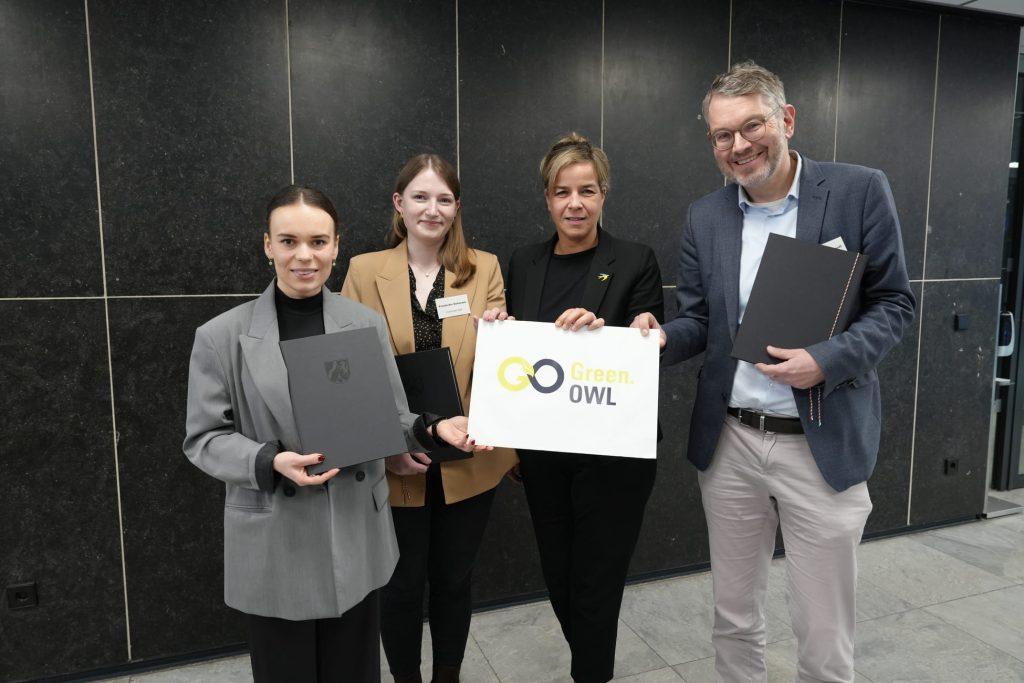
Circular economy, resource efficiency, climate protection: The sustainability transformation of the economy is an important foundation for the future of the OstWestfalenLippe region — and at the same time a major challenge for local companies. With the project “Green.OWL,” OstWestfalenLippe GmbH, together with Fraunhofer IEM, the University of Paderborn, and 40 other associated partners, aims to implement an innovation offensive for a sustainable economic region. The partners plan to develop a regional master plan and concrete support offers for small and medium-sized enterprises (SMEs). The three-year project is funded under the Regio.NRW – Transformation program with state funds and resources from the European Regional Development Fund (ERDF) with around 1 million euros. On Tuesday, Mona Neubaur, Minister for Economic Affairs, Industry, Climate Protection and Energy of the state of NRW, handed over the funding approvals to the three project partners.
Minister Neubaur: “Economy, research, and municipalities in OstWestfalen-Lippe work hand in hand with innovative and inspiring networks. I am pleased to support further exciting initiatives from the ‘Regio.NRW – Transformation’ call, which underpin OWL’s strength and innovative power and contribute to the region’s and the state’s future viability. With the focus on sustainability, climate neutrality, and circular environmental economy, the project teams are setting the absolutely right priorities for the region’s future-oriented transformation.”
Björn Böker, Managing Director of OstWestfalenLippe GmbH, explains the motivations and goals: “There are already many good ideas and projects for intelligent energy supply, circular economy, and climate protection in OstWestfalen-Lippe. Now it is important to show that sustainability is not just a buzzword for the economy, but offers real added value. With the project, we can make new technologies and research experiences available to our economy. And for the first time initiate a bold, comprehensive regional sustainability concept for our region.”
Master plan for the region and tailored offers for SMEs
The Green.OWL master plan will define goals, indicators, measures, and projects supported and implemented by business, science, and politics in OWL. “We will prepare current results from sustainability research and develop concrete measures and indicators in the areas of energy supply, circular economy, mobility, and buildings,” explains Prof. Dr. René Fahr, Vice President of the University of Paderborn.
In addition, tailored support offers will be launched that are tailored to the needs of small and medium-sized enterprises. “In close coordination with companies, we develop solutions that help them identify potentials, take initial steps, find partners, and develop a comprehensive concept for their operation,” explains Dr. Arno Kühn, Head of Department at the Fraunhofer Institute for Mechatronic Design IEM. These include, for example, a business model, quick checks, a solution toolbox, and implementation workshops. Moreover, sustainability managers will be trained in small and medium-sized enterprises and business-related organizations.
An important component for securing the future of OWL — and the German industrial location
The project enjoys strong support in the region. Involved are companies, universities, innovation networks, chambers of commerce and crafts, sustainability initiatives, and economic development agencies from the districts and cities. Wolfgang Marquardt, authorized officer of OstWestfalenLippe GmbH, emphasizes the importance of the project:
“Green.OWL is a central component of the new location strategy of OstWestfalenLippe GmbH. I am convinced that with our regional master plan, we will set new standards for a sustainable industrial region and make an important contribution to the competitiveness of industry at the German location.”