

From Dunkirk through Amsterdam to Aachen: United for a Future-Ready Construction and Planning Strategy
The construction sector in Northwestern Europe is responsible for 40 percent of CO2 emissions, making it a major driver of human-induced climate change.
It is essential to counteract this development. One effective measure is the use of circular materials and products. These refer to building components that can be reused in suitable form after their original use. Concretely, this could mean, for example, that beams once used for roof trusses can be used again in exactly the same function in their “next life.” If they can no longer fully serve their original purpose, they might be repurposed “in the next best way” — for example, transformed into façade cladding elements. This is precisely the concept of the “circular construction industry,” which aims to close loops and thus save resources and energy.
To achieve this, new approaches to urban planning are also indispensable. Spaces are needed both for storing materials and building components recovered from demolition at well-connected locations and for cultivating bio-based building materials such as wood, reed, and flax. Since these materials are only available on a supra-regional scale, supply chains must also change accordingly. The region between northern France and the major metropolitan areas in the Benelux countries (Belgium, Netherlands, and Luxembourg), the Ruhr area, and the Rhineland is known as the “Eurodelta.” Situated between the Rhine, Scheldt, and Meuse rivers, the Eurodelta offers a unique opportunity to lead the “construction turnaround” thanks to its favorable natural location, financial strength, expertise in construction and materials technology, and transport infrastructure.
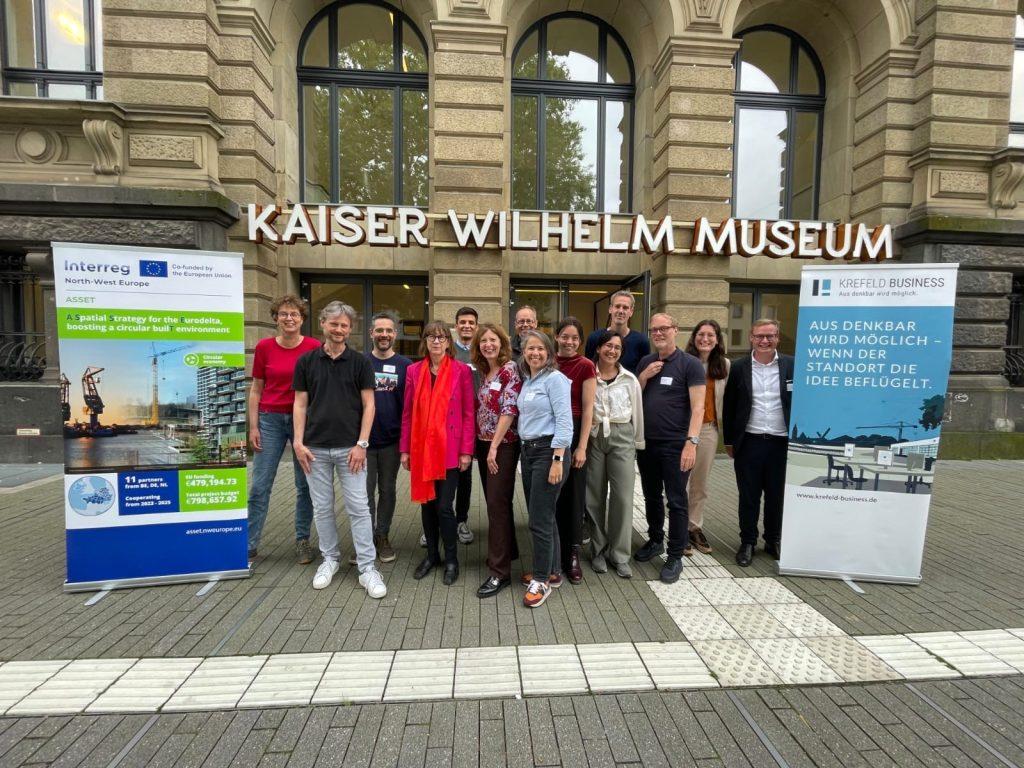
The aim of the INTERREG project called ASSET (A Spatial Strategy for the Eurodelta boosting a circular builT environment) is to learn from each other, collaborate more intensively, and develop a regional implementation strategy. Project partners include, alongside KREFELD BUSINESS, the cities of Amsterdam, The Hague, and Brussels, as well as the technical universities of Delft and Aachen. Krefeld’s partner city Dunkirk participates as an “associated partner.”
At the Lower Rhine and neighboring Limburg, various projects focusing on healthy and sustainable building have already been successfully implemented. These include, for example, the Krefeld Healthy Building Movement, sustainable daycare centers, and the Venlo administrative building.
KREFELD BUSINESS coordinates the project for the city of Krefeld and the Dutch-German border region. “Through the unique approach of linking sustainable buildings with the topic of ‘health,’ we position our region in the Eurodelta. At the same time, we strengthen our regional economy by supporting the development of new sustainable products, services, and business models,” emphasizes Eckart Preen, head of KREFELD BUSINESS.
Contact: Business actors interested in the project and wishing to participate can obtain further information from Dr. Simon Jenniches (02151/82072-22, simon.jenniches@krefeld-business.de) or Anna Appenzeller (02151/82072-25, anna.appenzeller@krefeld-business.de) at KREFELD BUSINESS.