

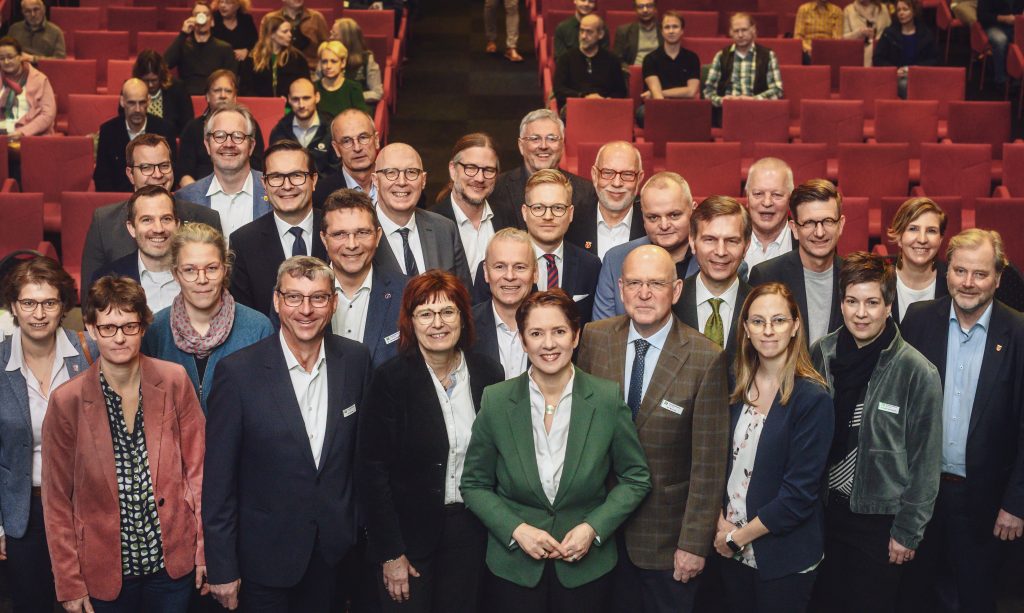
The 5th Lower Rhine Agricultural Forum at Wunderland Kalkar attracted great interest. North Rhine-Westphalia’s Minister of Agriculture, Silke Gorißen, emphasized the importance of the local agricultural sector for supplying people with food and sees many opportunities for local farmers despite challenging times.
What does the future of agriculture on the Lower Rhine look like between global competition and regional value creation? This question was the focus of the 5th Lower Rhine Agricultural Forum, to which the Economic Development Agency of the Kleve district, together with the Chamber of Agriculture of North Rhine-Westphalia, had invited participants to Wunderland Kalkar. The event was financially supported by the cooperative and savings banks in the Kleve district. More than 200 representatives from agriculture, politics, business, and associations came together to discuss current developments and prospects for the sector.
District Administrator Christoph Gerwers opened the event and emphasized the great importance of agriculture for the region: “As the Kleve district, we are proud to be one of the strongest agricultural regions in North Rhine-Westphalia. Our farms not only shape our cultural landscape, but also our identity.” He continued: “Agriculture today is facing major changes. It operates in a field of tension between global markets and regional responsibility. Between increasing demands for sustainability, animal welfare, and climate protection on the one hand—and economic pressure, competitiveness, and international trade agreements on the other.” However, Gerwers also sees an opportunity for local farmers, “because our region, with its innovative strength, expertise, and strong network of agriculture, refinement, processing, and marketing, is excellently positioned to actively shape this transformation.”
An impulse on the current agricultural policy situation was provided by Silke Gorißen, Minister for Agriculture and Consumer Protection of the state of North Rhine-Westphalia. She emphasized the importance of local agriculture: “Hundreds of thousands of jobs in NRW depend on agriculture. Agriculture is systemically relevant; it ensures the supply of food to the population.” According to the minister, agriculture operates in an “enormous area of tension,” as food must be produced at consumer-friendly prices while at the same time complying with strict environmental regulations and meeting increasing demands for animal welfare. In addition, farms must address the challenges of climate change. “The key lies in innovation and knowledge transfer,” said the minister. She sees great potential in integrating AI and robotics into agricultural practice. With regard to the Mercosur free trade agreement, Gorißen stated: “A differentiated perspective is important. The agreement offers great opportunities for Europe and thus also for the agricultural sector in NRW and the export of our products.”
Eric von Berg-Wallner, Head of Foreign Trade at the Lower Rhine Chamber of Industry and Commerce in Duisburg-Wesel-Kleve, has also examined the EU-Mercosur agreement in depth. In his presentation at the Agricultural Forum, he provided an overview of the contents and possible effects of the trade agreement between the European Union and South American countries.
The subsequent panel discussion made it clear that assessments of the agreement vary. Among other things, participants discussed the potential impact of additional imports on European production standards and competitive conditions. Alongside von Berg-Wallner, the panel included Erich Gussen, Hermann Schmitz, Karl Werring, and Martin Wilmsen, farm manager of an arable farm in Kalkar.
In addition to global framework conditions, concrete practical examples were also a focus. In a second session, farmers and industry representatives presented successful projects and innovative approaches that inspire confidence. Participants included Wilhelm Hellmanns, Annika Frank, Andrea Peters, and Simone Schmitz. They demonstrated how farms are responding to current challenges with new marketing channels, specialization, or sustainable production methods.
The event was moderated by Andrea Franken. During the subsequent exchange and over a delicious serving of kale, participants took the opportunity to deepen discussions and establish contacts.
In recent years, the Lower Rhine Agricultural Forum has established itself as an important platform for dialogue and networking between agriculture, politics, and business. The fifth edition once again made it clear: agriculture is undergoing transformation—but the region has many ideas, initiatives, and committed stakeholders to actively shape this change.