

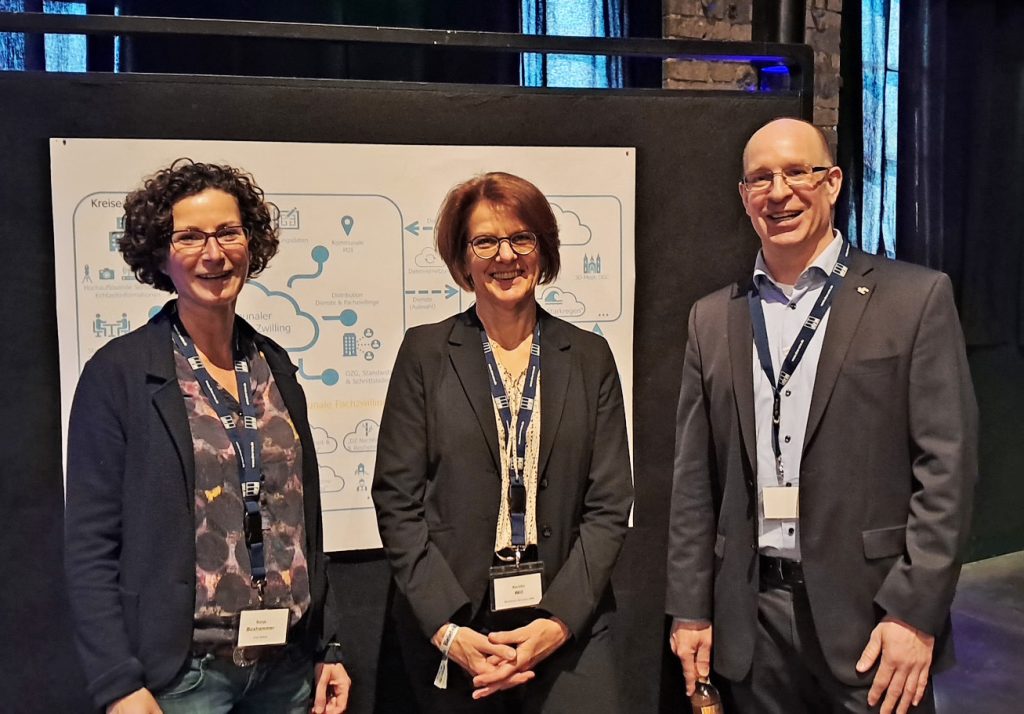
The funding project “Digital Twin Rhein-Kreis Neuss” has now gained supraregional popularity. At the specialist conference “Forum Geodesy” in Bielefeld, organized by the German Association for Surveying (Deutscher Verein für Vermessungswesen), which promotes networking on current topics of geoinformation and land management, Rhein-Kreis Neuss presented the project and its current development status. “Our ‘Digital Twin’ has already sparked strong interest. The concept has been requested by other districts that also want to introduce such an offering,” emphasizes Harald Vieten, IT Director of Rhein-Kreis Neuss. “Our district leverages the opportunities and possibilities of digitalization and drives the implementation in a forward-looking and consistent manner. The ‘Digital Twin’ project is an excellent example of this.”
The “Digital Twin Rhein-Kreis Neuss” consolidates geodata from the municipal administrations along the Rhine, Erft, and Gillbach rivers to make the real world experienceable on a screen. Users get access to high-resolution, three-dimensional 360-degree image data, comparable to virtual reality. “This enables the visualization of planning projects and simulation models in the areas of mobility, traffic, construction, climate, environment, and economy,” explains Michael Fielenbach, Head of the Cadastre and Surveying Office of Rhein-Kreis Neuss. “Additionally, the project serves as a basis for Smart City applications.”
Around 220 participants attended the “Forum Geodesy” conference, including representatives from cities, districts, states, federal authorities, professional associations, and the District Association. The conference also highlighted the central role of geodata management in district administrations as important coordination points for the municipalities within the districts. Rhein-Kreis Neuss received great interest with its project presentation, represented by its geodata expert Christoph Kany.
Besides an animated compilation of application examples, the second current planning phase of the development of a district-wide uniform urban data platform was presented. This platform is part of the “Digital Twin” and is intended to enable cooperation and data networking between municipal data stocks as well as state and federal data. Prior to this, technical representatives from the North Rhine-Westphalian districts (cadastre and surveying offices) had coordinated content-wise in the working group on geoinformation and surveying of the District Association.
At its core, the urban data platform represents a foundational and bundling function, where all municipal specialized data in the Digital Twin can be related to and visualized with other data and made available with municipal tools, analyses, and simulations for local planning tasks. A key feature is the use of standards and interfaces that enable collaboration with other data-managing entities.