

Smart City Summit Lower Rhine held for the fifth time in Mönchengladbach
“It’s possible,” “Good groundwork, I can build on this,” “I’ll start tomorrow!” – thoughts like these were what visitors of this year’s Smart City Summit Lower Rhine in Mönchengladbach were meant to take away. With this goal in mind, the organizers opened the professional congress on digital urban development in the Lower Rhine on Thursday, which took place for the fifth time this year. The mix of lectures, workshops, networking, and a large exhibition area provided the perfect setting for this.
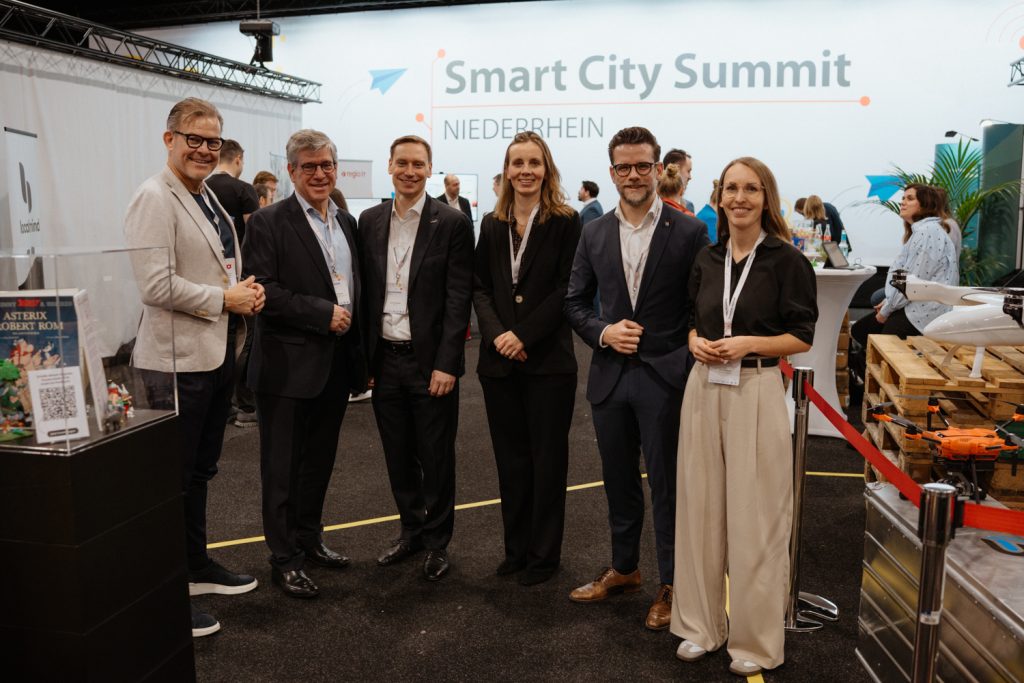
The fact that the event has established itself as a fixed institution for professionals and companies was evident from the packed rows and the lively activity of nearly 500 visitors in the NEW Box in Nordpark. “Data-driven decisions are the better decisions,” outlined Mönchengladbach’s Mayor Felix Heinrichs, describing the guiding principle of smart cities, in which data is collected, networked, and used for concrete applications. Kira Tillmanns, head of the city’s Smart City program, sees major development in recent years: “We started as a small innovation unit; now it’s about using the Smart City infrastructure and rolling out wide-reaching applications.”
From digital robots to the AI seahorse
The Smart City Summit combines strategic perspectives with illustrative practical examples. On the main stage, lectures covered topics such as digital robots (bots) that fully automate recurring, rule-based administrative tasks. But also addressed were the balancing act between innovation and financial limits, new forms of municipal governance, strategy and security aspects in the use of artificial intelligence, and case studies from the Netherlands. This year, the Netherlands participated as the official partner country, represented at the Summit by digital companies and the Dutch Consulate General.
In the workshop sessions, participants had the opportunity to dive deeper into topics. Questions on LoRaWAN – a wireless standard for sensors – were answered, sensors installed in Nordpark for traffic monitoring at large events were presented, best practices from digital urban development were discussed, and the “AI seahorse” was earned.
35 exhibitors across approximately 5,000 square meters
The heart of the annual “summit meeting” of the smart city world is the roughly 5,000-square-meter expo area. At numerous booths, exhibitors presented their projects and solution approaches for the digital city of tomorrow. Municipal professionals from Nettetal, Aachen, Rhein-Kreis Neuss, and Dormagen also had their own stands. Experts from Hamm, Krefeld, and Nettetal contributed keynote lectures on the main stage. The cross-city exchange, in which municipalities learn from and with each other, jointly develop solutions, or adopt successful approaches from one another, is a core idea behind the federal Ministry of Housing, Urban Development and Building’s Smart City funding, in which Mönchengladbach is financially supported as one of 73 model municipalities.
In the expo area, smart urban development is made visible, and exchange around concrete products, ideas, and approaches is enabled. Exhibitors presented, among other things, sensors for measuring visitor frequencies and tracking traffic flows in a data-protection-compliant manner, technology for smart parking management, or drones designed to transport urgent medical samples to laboratories. But it was not just hardware that shaped the picture. Many digital solutions and strategic approaches were also presented. From AI agents to the virtual 3D city model (“digital twin”), which Rhein-Kreis Neuss wants to integrate with the one from the Neuss city administration, to the city app for which Mönchengladbach plans to test a beta version this summer.
The constant hum and buzz in the exhibitor area reflected many lively conversations – and some animal participants. A beehive, for example, can become a measuring station with appropriate sensors to monitor biodiversity and predict heavy rainfall. Virtually represented was Bee Max, who, via a VR application, introduces children playfully to nature and waste separation. Not an animal, but equally endearing, is little Vitus – the chatbot that the city of Mönchengladbach will soon offer on its website. The AI chat application could be tested at the Summit – contributing in its own way to visitors leaving the Summit with new acquaintances, fresh impressions, and interesting information.
About the SmartCity-Summit.Lower Rhine
The first edition of the SmartCity-Summit.Lower Rhine in 2021 marked the start of an innovative series of events intended to put Mönchengladbach on the nationwide Smart City map. The SmartCity-Summit.Lower Rhine is organized by the city of Mönchengladbach with its Smart City program area, the Marketing Gesellschaft Mönchengladbach, the Economic Development department, NEW, and mags.